Vampire Therapist review - “The problems of unlife aren't so black and white.”

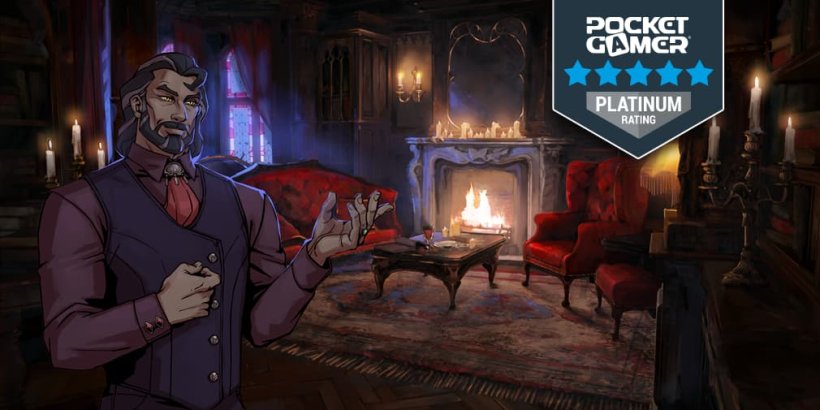
For over a century now, the vampire has fascinated humanity. From books to films, television and yes, even video games, the enigma of an undead bloodsucker that nonetheless has the wisdom of the ages is a contradiction we all seek to understand. Vampire Therapist isn’t concerned with tragic backstories or merciless sadism but with how to move past them.
In Vampire Therapist, you play undead cowboy Samuel Walls, who is invited to Germany by the three-thousand-year-old Andromachos. For some devious scheme? No, but to help other people. Vampires, that is. Because, as Samuel Walls, you are the one and only Vampire Therapist. And God help you, because these bloodsuckers have some problems.
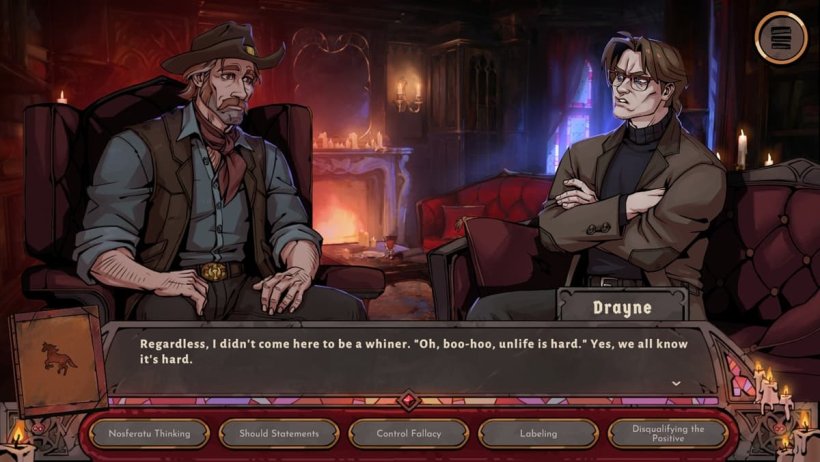
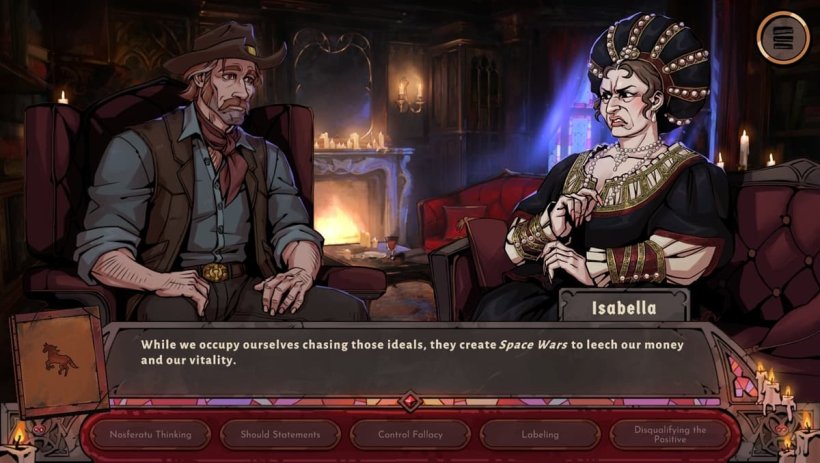
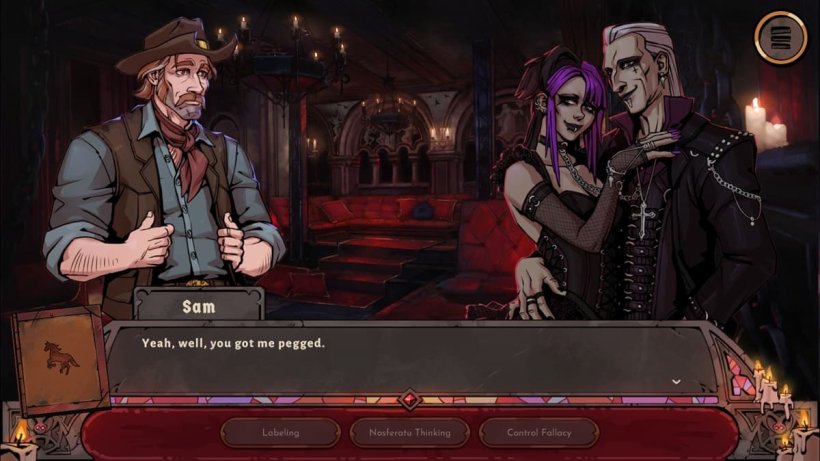
It can seem a little gamified, but there is definitely a fascinating deductive element to catching your client doing things like Labeling or Disqualifying the Positive, all of which seem to be real therapy terms, but which are explained in a digestible format. The focus is not on catching out your clients, but on taking advantage of these contradictions to show them where they can manage their problems.
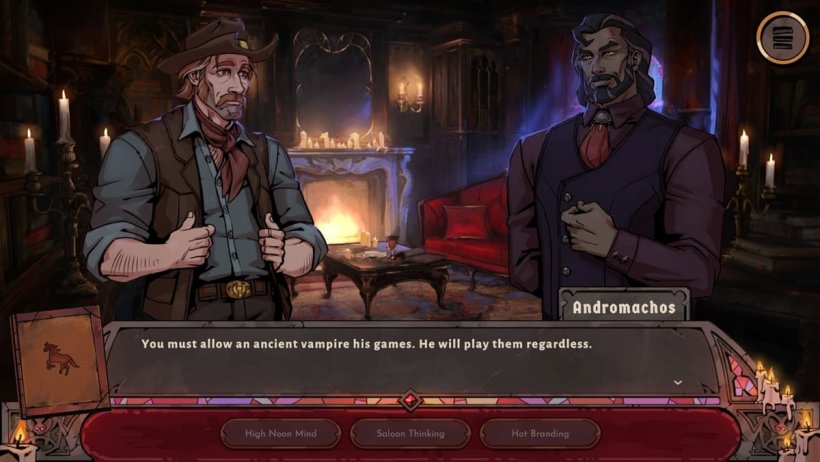
You’ll also get to make occasional decisions on what to say or do, which can shift the story in different directions. The focus is mainly on the psychological element, and that in itself is enough to carry the whole game. In fact, I was a little miffed when it got interrupted by a blood-drinking minigame, not least because it was a little janky in the build which I played.
Whenever you have an issue, you can look back at your notes to study them for references to your client’s case files, as well as Sam’s notes that point to the issues they have. You can also look up definitions of the psychological contradictions, including some handy examples. Admittedly, I missed these on my playthrough, but they are there if you’re the journal-reading type, and Andromachos will be on hand to guide you through initial sessions anyway.
The music in Vampire Therapist is pretty simple, consisting of the main theme and occasional background noises. I did find the track that plays in the vampire club, which your patron Andromachos uses as his base of operations, a little repetitive, which can be an issue since you revisit it pretty frequently.
The voice acting, however, is undoubtedly a standout. Naturally, Matthew Mercer provides his vocal talent as incidental character Reinhard, and also appears later on in the full game. But Cyrus Nemati is a standout as Sam Walls, who provides cosy mix of stereotypical gravely cowboy and surprisingly self-aware, world-wise wanderer.
The motivations and backstory for your clients also manage to quite elegantly marry typical vampiric tropes with more realistic psychological conditions. Doctor Drayne struggles with addiction, only it’s to an experimental plasma he’s been making at his pharmaceutical company as part of a synthetic blood substitute.
The Contessa d’Este, meanwhile, is a literal Renaissance woman who struggles with depression and anger at the world, because after funding the great arts in her heyday, seeing Space Wars: Rise of Spacewalker (no prize for what that’s parodying) made her think all her efforts to enlighten humanity were for nought.
About the only issue I had is that Vampire Therapist, for what I played at least, seems to sidestep some more pressing issues and leaves a lot of questions unanswered about character motivations. Drayne, for example, is mostly concerned that his addiction to the experimental plasma is affecting his workaholic lifestyle, but the fact he has no memory of what happens when he consumes the substance isn’t given any attention at all.
Admittedly, it’d be a bit awkward to delve into Andromachos’ backstory as the Terror of the Mediterranean, and it might well be something brought up in latter parts of the story. Still, it can feel as though there are some elements that should be explored further, especially as we do get a lot of detail about Sam Walls’ path to redemption even in the first part of Vampire Therapist.
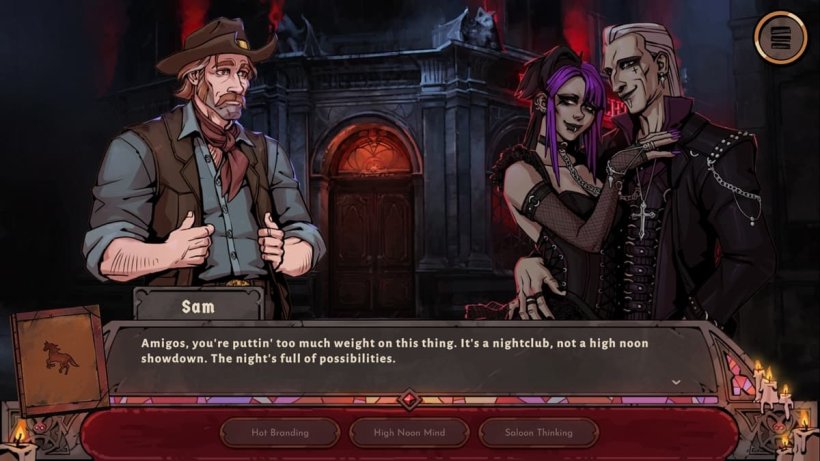
The only problem is that it does presume a lot about the player and how they want Sam Walls to act. Especially considering one early section has Walls nibbling (consensually) on some goth necks in a very sensually implied manner. It’s not as though you’re not warned that it delves into mature topics, but if you’re like me and couldn’t stand the romance in something like Baldur’s Gate 3 it can still feel a bit awkward.
But those are small potatoes, and my earlier mention of stuff I think the story could have done better is only evidence of how much I was paying attention to, and absorbing, the world and its characters, which I think is the highest praise you can give anything narrative-based. It’s lightweight, narrow in scale and perfect for relaxing while offering something of a challenge as you learn more about your clients and try to help them ground themselves and, if not resolve, then at least manage their problems.
This makes Vampire Therapist feel worthwhile for fans of vampire fiction, as well as those just looking for a fascinating story. Add to that the intriguing explanations of therapy terms, psychological distortions and explorations of the (in)human condition, and ironically it feels as though a game about vampires helps to demystify the idea.
If you’re looking for a solid visual novel with a bit of meat on its bones, and some great art and audio that elevates what rather bashfully calls itself a low-budget indie, then Vampire Therapist is a must-play!

