Interview: Find out how Echoes of Revolution brings American history to life through Assassin's Creed
Get ready for a revolution
- Echoes of Revolution is an upcoming XR project to mark America's 250th founding anniversary
- Ubisoft partnered with Sugar Creative to use recognisable assets to bring revolutionary America to life
- We got to put our questions to managing director, Jason Veal to find out more
It's sometimes difficult to remember how young the United States is as a country. And while the upcoming 250th anniversary of the nation's founding isn't quite a centennial, it does mark a quarter-century since it was established. So, it's not surprising there have been so many big announcements, including in gaming, for the celebration.
France and the United States have historically close ties (the Statue of Liberty was originally made in France, after all), and Ubisoft have brought on Sugar Creative to once more bring the world of Assassin's Creed to life. They have already worked with Ubisoft for the educational app Discovery Tour: Baghdad, based on the previous release Assassin's Creed: Mirage.
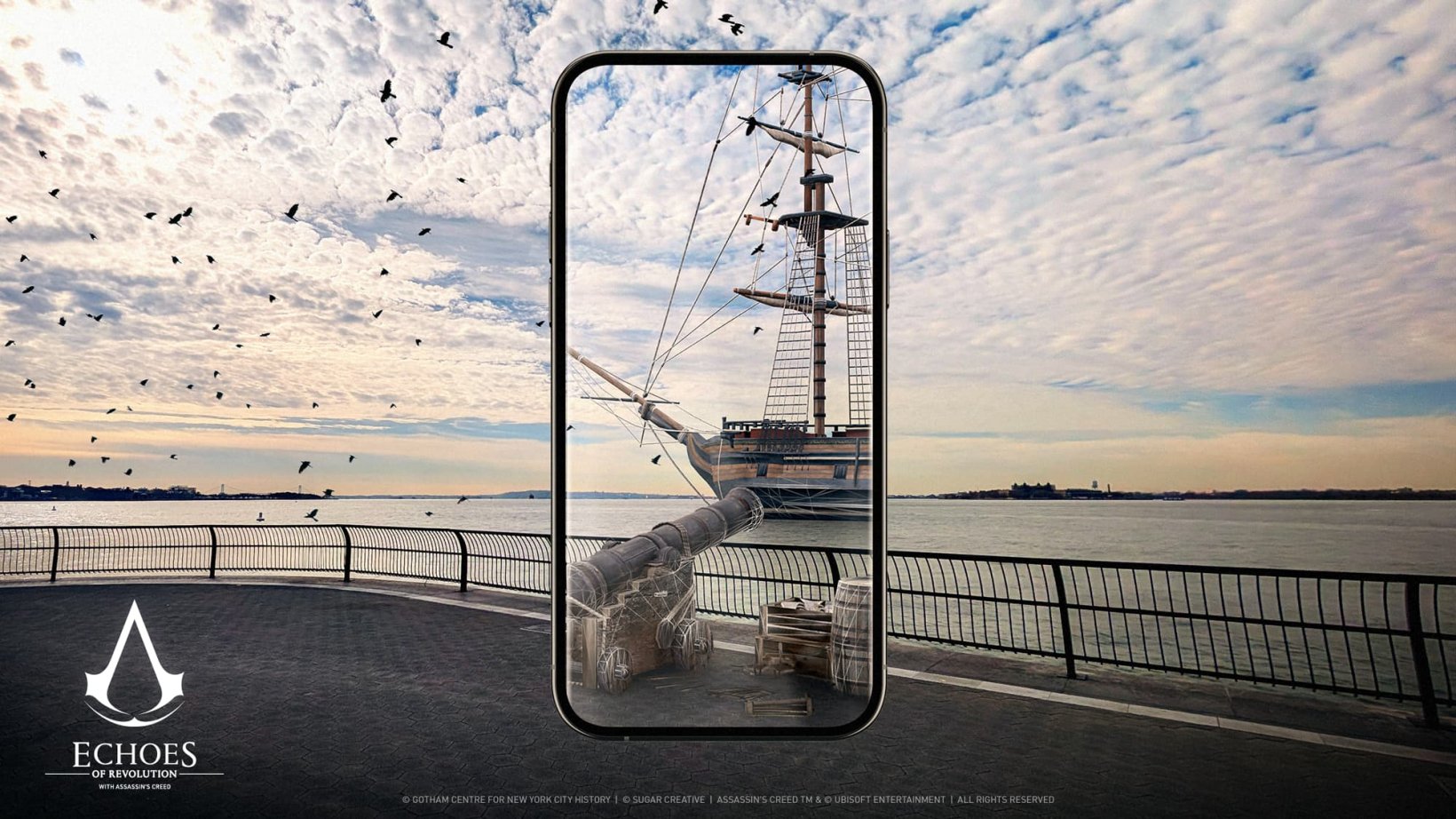
The upcoming Echoes of Revolution experience is an XR (extended reality) app that will let visitors to Boston and New York this year experience digital recreations of historical perspectives. It's an ingenious way to bring together one of Ubisoft's most famous franchises and the real-life historical angle that has defined it.
Assassin's Creed obviously has its own strong history with America, too. Assassin's Creed 3 was the big jumping-off point after Ezio's storyline, and even had its own spinoff sequel with Assassin's Creed Liberation.
Naturally, we wanted to know more. So we reached out to Sugar Creative's managing director, Jason Veal, to learn more about what Echoes of Revolution really is, and what you can expect as an Assassin's Creed fan or a history buff.

Our starting point was actually our earlier collaboration with them on 878AD: Winchester Revealed, which showed how using Assassin’s Creed imagery and historical research could help younger and more diverse audiences connect with history in a meaningful way.
That project demonstrated something important. Assassin’s Creed can act as a powerful bridge. It brings brand recognition and trust, but it also brings an extraordinary depth of historical research.
The worlds Ubisoft builds are not superficial. They’re underpinned by years of academic work, archival material and contextual detail, which makes them a strong foundation for historically grounded experiences.
With Echoes of Revolution, the opportunity is to carefully draw on that richness. We’re using selected assets and research from Assassin’s Creed III, but always in service of the real history and the real locations.
The experience isn’t about retelling the game’s narrative. It’s about using the Assassin’s Creed universe as a familiar lens through which people can explore authentic historical moments, right where they happened.
Brand awareness plays a crucial role here, particularly for engaging audiences who might not normally seek out heritage content. But it’s deliberately balanced. The goal is to invite curiosity and exploration, not to overwhelm the history. In that sense, Assassin’s Creed becomes an entry point, while the city, the place and the history remain at the centre of the experience.
Obviously, many American readers will already know. But can you explain what made Boston and New York such important cornerstone locations for Echoes of Revolution to be available in?Boston and New York are absolutely foundational to the story of the American Revolution. They weren’t just backdrops, they were active stages where political tension, protest, daily life and pivotal events collided.
Rather than trying to tell the entire story of the Revolution, Echoes of Revolution focuses on key moments, places and lived experiences that shaped the early years of the nation. That includes major flashpoints, but also the everyday environments where ideas spread, alliances formed, and conflict escalated.
Both cities lend themselves incredibly well to this approach because so much of the original urban fabric still exists, especially in Boston. You can stand in the places where these events unfolded, which makes the experience of uncovering them through XR far more powerful.
Can you help us understand how XR works, and how people can use it in the real world? Why use that term instead of AR? How are the two different?We use the term XR because it better reflects the blend of technologies and experiences involved. Traditional AR often focuses on overlaying content onto the real world, usually through a camera view.
XR allows us to move more fluidly between augmented elements, spatial audio, 360 environments, narrative layering and moments that feel closer to mixed reality.
The advantage is that it lets us design experiences that feel less like looking at a screen, and more like being inside a story. Especially in city-scale projects, that flexibility is crucial. We’re not trying to dominate the real world with visuals. We’re trying to enhance it, guiding attention, emotion and understanding in a way that feels natural and accessible.

So, is that kind of flexibility why XR has become so important in your catalogue?
Sugar Creative sits at the intersection of storytelling, technology and place. We’ve worked across entertainment, education and culture, often with heritage organisations, cities and major IP holders.
XR has become a focal point because it allows us to bring those strands together in a way no other medium really can. It lets us tell stories where they happened, at scale, and for broad audiences.
Projects like Wallace & Gromit: The Big Fix Up & 878 AD: Winchester Revealed were important stepping stones that showed how powerful that approach could be. Echoes of Revolution is the natural evolution of that thinking, just on a much bigger canvas.
Echoes of Revolution is coming at a time when all of America will be celebrating. And that means you're almost certain to have many people giving it a go because of that. Are you excited about how many people will get to experience it?Yes, it will be our most visible project to date. The experience is free, mobile and built for public space, which immediately removes many of the barriers that limit participation in XR.
Because it’s tied to tourism, education and a major national moment, we expect it to reach audiences well beyond the traditional gaming or XR crowd. That’s incredibly exciting for us. It’s also a responsibility, which is why so much effort has gone into making the experience accessible, intuitive and meaningful.
We hope so. Wales has a genuinely strong creative and games ecosystem, but it doesn’t always get the international visibility it deserves. Being able to take a project conceived and developed in Wales and deploy it at city scale in the US is a powerful statement about what Welsh studios are capable of.
If Echoes of Revolution helps shine a light on Welsh creative talent and opens doors for others, that’s something we’d be very proud of. We’ve benefited enormously from Welsh innovation support, and this feels like a clear example of that investment paying off globally.
Speaking of America's 250th anniversary, it's a once-in-a-lifetime event for you to highlight. How does it feel to know many Americans will be celebrating, at least in part, by experiencing their history with Echoes of Revolution?It’s humbling, to be honest. We’re very conscious that we’re dealing with history that matters deeply to people. That’s why this is about inviting exploration rather than delivering lectures or opinions. We believe the future of learning is in exploration, not instruction. The goal isn’t to tell people what to think, but to help them connect with the past in a more personal and immediate way.
Working with historians, cultural partners and Ubisoft’s own research teams has been essential. The responsibility is real, but so is the opportunity to engage people who might not otherwise seek out this history at all.
To wrap things up, can you give us any hints about future projects and what might be next for Sugar Creative after your recent work with Ubisoft?What these projects have shown is that there’s huge potential in taking a major gaming IP universe beyond traditional formats and into real-world, location-based experiences. We’re excited about that direction, but it’s still early.
What we can say is that we see this as the beginning of a broader conversation around how large-scale XR can bring history, culture and major IP into public space. Where that goes next is something we’re actively exploring together, but for now our focus is on delivering Echoes of Revolution to the highest possible standard.
