The Big Question: Just how much is too much for a smartphone game?
- How much is too much to pay for a mobile game? Well, that depends
- There's worth vs cost, how long a game has been around and numerous other considerations
- But let's try to answer one of the key questions of our age in today's feature
One of the greatest appeals of mobile gaming is how relatively cheap it is. After the cost of a phone, there are hundreds of free-to-play games you can enjoy on a smartphone. However, the recently announced port of Monster Boy and the Cursed Kingdom with its $24.99 price tag is not one of them.
Seeing this got me thinking, though. Why do we have such a visceral reaction to premium games on smartphones? At what point are you paying too much for a mobile game? Or are we, in fact, used to paying too little for them?
Worth vs Cost
Now, I should preface this with one key point. How much someone feels a game is worth paying for can be at odds with how much it should cost, whether higher or lower. We see it on Steam all the time with indie developers having shockingly low margins, and not always feeling like they're able to justify a price increase to fans used to seemingly permanent sales and rock-bottom discounts.Equally, prices have been creeping up on virtually every platform. And mobile is no exception; even if we've had the spectre of microtransactions and gacha skimming money off the top, the idea of paying more than $20 upfront still sends shivers down many players’ spines.

In my opinion, that response isn't exactly unjustified. Monster Boy and the Cursed Kingdom, for example, is on sale for a whopping $24.99, which is roughly equivalent to its cost on Steam. But whereas Steam gamers can wait for a sale, on mobile it's either pay up or tough luck.
And while I'll defend mobile as a valid platform for even the most hardcore gamers, many ports or adaptations do come with significant technical caveats. Smaller screens, lower visual fidelity or awkward controls that do make it feel like a less-than-ideal (but not necessarily bad) experience.
Survival horror
But even that isn't the highest price you'll pay on mobile, with Resident Evil 4 on iOS up for an absolutely gag-inducing $59.99. Of course, this is a full-fledged mobile adaptation with all the bells and whistles. But it's also only available on the already pricey top-flight iPhones, and comes with its own significant technical caveats in terms of both fidelity, playability and even just heat management.
And as I pointed out in one of my own features, I think that Resident Evil on iOS was intended more as a tech showcase than anything else. Ultimately, Resident Evil can work on mobile, but it'd need to be a game designed specifically for the device and its limitations. Although that's how we got Resident Evil Survival Unit.
Resident Evil 4 Remake may be a fantastic game. But it's one that was designed specifically for big-screen consoles and PCs. And no matter how polished it may be or how high-powered the device, this inevitably means corners have to be cut, and that makes the price associated with it sting all the more.
Freeware to live
Now, it wasn't always like this. Go back to the dawn of mobile gaming, and you'll find the difference between 'lite' and 'premium' mobile games to be quite prominent. Hits such as Angry Birds and Jetpack Joyride all offered lite (essentially extended demo) versions of their games to entice players.Is that a model we should go back to? Maybe, and we have seen many developers and publishers start leaning in that direction. Feral Interactive, for example, have made many of their ports of the Hitman series free-to-try, letting players get a taste of the action before they play. That way, you can decide if it's worth the price of entry without losing anything.
The dev question
All of this arguing back and forth comes with one key caveat, however. We're also talking about developer livelihoods and publisher costs here. Something which all too often falls by the wayside in discussions about pricing.If nothing else, the Epic Games vs Apple & Google saga highlighted how much these storefront owners skim off the top when it comes to sales, meaning what actually goes to developers (especially when you take off development costs and money paid to publishers), the profits are incredibly low.
That's just not sustainable for indie studios, or even some smaller mainstream developers, on mobile. Many players are willing to shell out the equivalent amount of money for gacha, microtransactions, and season passes, but when that money is upfront, suddenly you don't have the veil of it being spread out to mask the actual cost.
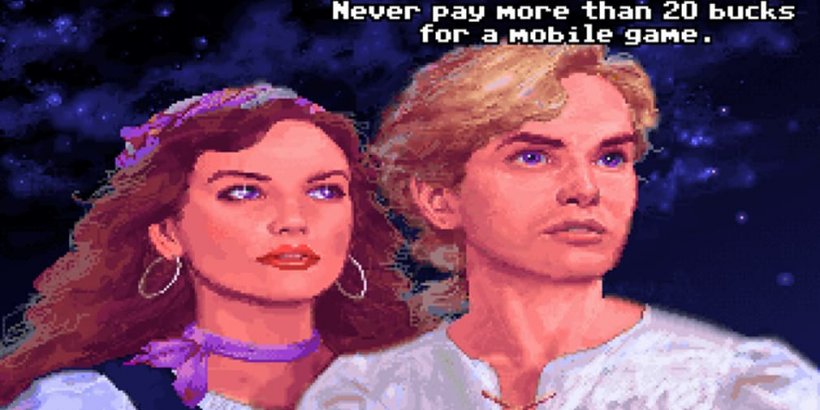
'Never pay more than 20 bucks for a computer game'
Unfortunately, I think we're just used to rock-bottom prices on mobile. And yet those small transactions can build up to the same as one of those eye-watering price tags over time. And those microtransactions could be blamed for why mobile still has a sticky reputation of solely being free-to-play junk.After all, if devs can't make a living on mobile with premium releases, why try when a gacha will make gangbusters for them with (comparatively) less effort? And even the most AAA-tier releases we have, such as Where Winds Meet, feel the need to draw in players with free-to-play.

But I don't want to sound as if it's your moral duty to shell out money. Monster Boy and the Cursed Kingdom may be a stylish platformer with a renowned designer behind it, but it's also almost a decade old. And many of the players willing to shell out $20+ for it already have. So for mobile gamers who don't know or care who Ryuichi Nishizawa is, it's a pretty big ask to drop that kind of cash.
Maybe in a few years, players will be eager to spend $50+ for a truly exceptional mobile experience. But right now? Well, for many that $20 will buy a lot of anime waifus to add to their gacha roster. And that instant gratification may be worth the money to them.
