


- Gambonanza is a new roguelike puzzler that hopes to do for chess what Balatro did for poker
- And it does so with a lot of style and flair, as well as some interesting mechanics
- But does it hold up in the all-important gameplay department?
Nowadays, the Balatro-like has become a genre all to itself. After Localthunk's massive smash-hit roguelike deckbuilder took the world by storm, many others have been inspired to create their own spins on popular tabletop pastimes. And the latest that hopes to make their mark is Blukulele and the chess-themed topic of today's review, Gambonanza!
Gambonanza transforms chess into a roguelike adventure where you collect new pieces and expand your available roster, use different 'Gambits' to pursue different strategies, and challenge bosses that offer their own distinct challenges. At first blush, it seems to basically ape Balatro, but scratch the surface and Gambonanza really stands on its own. But does that mean it holds up, too? Read on and find out.

Before we begin, you'll have to forgive me for all my references to Balatro, but even developer Blukulele themselves admit that they were heavily inspired by it. And that's not necessarily a bad thing either, as in terms of music and visuals, Gambonanza feels just as cohesive and aesthetically pleasing as its predecessor.
The music is something I think highlights its difference from Balatro. The sound is more energetic and upbeat, a little more 'you can do this!' rather than the 'like, whatever man' vibe of the latter. The fact that it changes based on whether you're between games or on a boss fight (with each having its own thematic twist) also means that you feel the urgency of victory a little more than in Balatro.
Visually speaking, Gambonanza pretty heavily apes Balatro's style, especially in that strange ink-swirl background. But it does manage to stand out with a more 'retro' pixellated look. Although I'm not a huge fan of the beige and brown colour palette, there are splashes of colour when the bosses make an appearance, which helps them stand out even further.
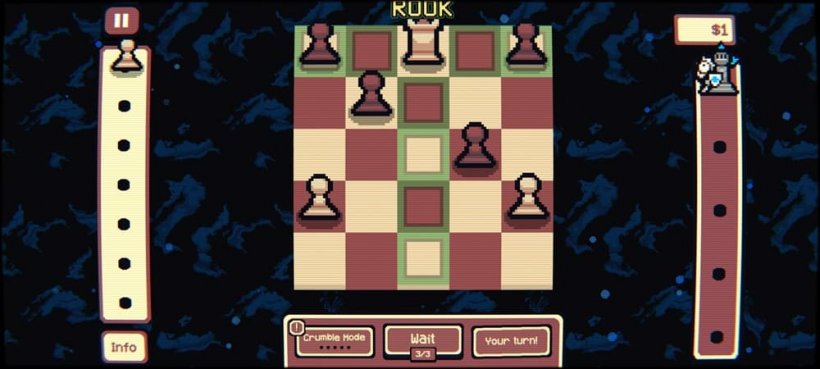
While Balatro often felt like it relied on obscure mathematics, Gambonanza plays to the strategy gamer in all of us. And whereas Balatro has often thrown me for a loop with poor card draws, in Gambonanza, it feels as if the power is always in your hands to outplay your opponent by baiting them out and placing them in untenable positions. Well, usually, but more on that in a moment.
Certain mechanics work to push the game forward and prevent a stalemate (although that still is possible to occur, mainly in boss battles). Crumble mode occurs after a certain number of turns and sees the board literally fall to pieces, meaning you can still win even if it's just one piece versus another. It's an ingenious means of keeping things moving forward without the need for a traditional chess timer.
At the same time, while the gameplay of Gambonanza is quite compelling, it also has some of the same pitfalls as its inspiration. Luck can feel like a significant element, and just as Balatro occasionally had the boss blinds that completely kneecapped your otherwise flawless strategy, certain bosses in Gambonanza can feel more than a little unfair in their particular gimmick.
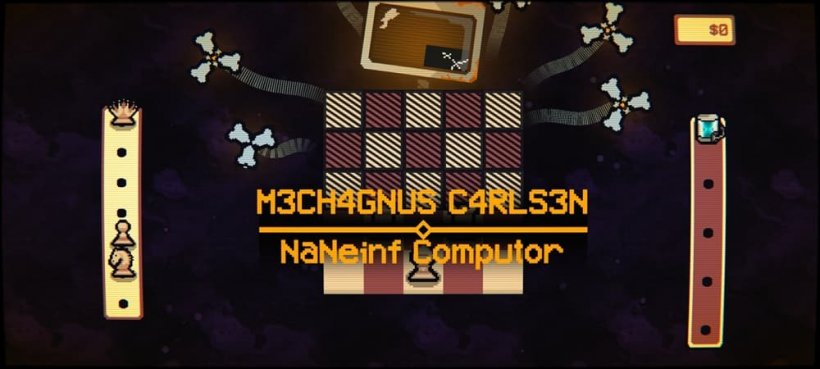
The Gambits can also feel a little too situational. In Balatro, certain Jokers had specific triggers, but you also had plenty with simple conditions like 'playing x card gives 2x multiplier' to help you keep up. Meanwhile, Gambonanza's Gambits do feel very true to the highly complex game of chess with their detailed triggers. However, they're so specific, and the difficulty spikes so quickly, that most of the time you'll be ignoring them in favour of adding more pieces with useful moves.
Some of these Gambits can be really useful, and actually synergise really well with normal chess gameplay. The Empress gambit that makes your Knights also move like Rooks is a fantastic example that offers a major boost. However, for every Gambit like this there are many others with particularly strange trigger conditions that may play to a very specific strategy, but don't offer anything for a more conventional approach.
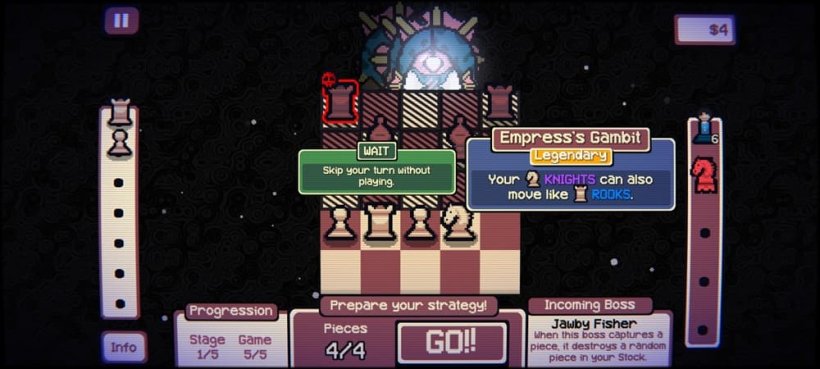
The same goes for Tiles. They convert one tile on the board (only one) to a certain type with different effects, be that giving more money or providing a temporary copy of a piece. But again, these come at the cost of missing out on Gambits and extra pieces, and means you have to intentionally play to use these tiles, which can often put you at a disadvantage.
This tension between the simple chess gameplay and roguelike elements is most easily seen in the permanent loss of pieces and promotions. You can promote pawns to better (a loaded term, I know) pieces as you do in chess. However, these promotions only last for a single game, resetting to a pawn afterwards, and the ability to pick different pieces confuses me when the option to take a Queen (the undoubtedly most versatile piece) is there.
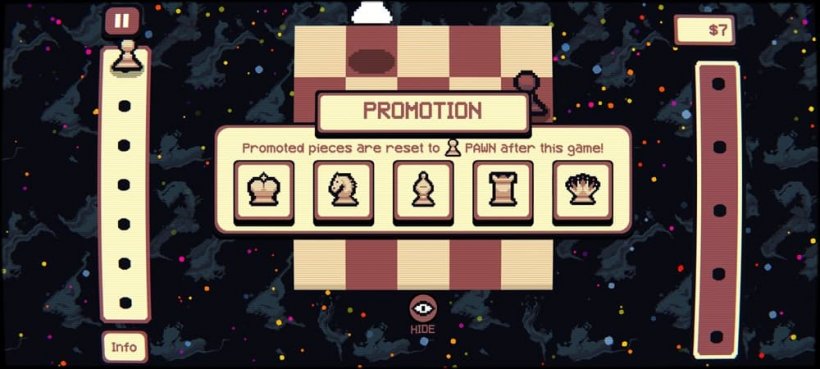
You also might find it particularly aggravating that any pieces lost are lost forever. Now, I know this is part of the design; there are a number of Gambits that encourage promotion by offering empowered pieces or which return your pieces to the 'stock' for use later if captured. But as I've already mentioned, this puts you in a frustrating position of being unable to pursue the various Gambits or Tiles and instead feeling you have to focus on rebuilding your forces after a particularly tense level.
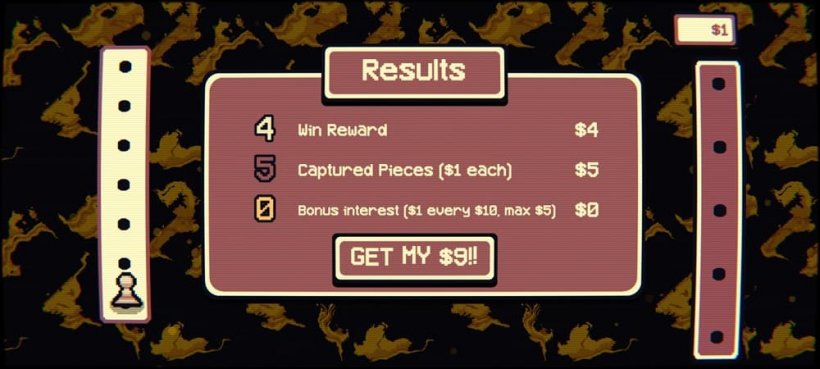
Put it this way. In the early game, a Gambit usually goes for $7. A random chess piece is $4 (with no guarantee you'll get one you want), and a random Tile can go for the same or up to $7 too. But you also have the upgrade to increase the number of pieces on the board, which scales from $10 to $15 and so on.
Which do you pursue? There's no simple answer. Even if, for example, you find a good gambit that relies on a queen, you have to hope that you either get a random queen piece or spend $10 on one you roll. Oh, and rerolls cost $2. And considering you'll only be scaling from $7 to $8, to $9 in rewards, and so on, you find yourself being strapped for cash early on, which means you'll take a lot of losses in the early stages.
Ultimately, that's the main frustration I have with Gambonanza, and it's that there are so many missing pieces and loose ends that match the fun with frustration. Some upgrades feel so situational that they're practically useless unless you're playing with exceptional macro strategy. And early on, you have to play flawlessly until the board (and the game itself) opens up to let you plan out more complex strategies and take advantage of the specific Gambits.
I've no doubt that experienced players of chess will find Gambonanza a lot more approachable. However, for me, it doesn't seem clear whether Gambonanza really wants to be an approachable roguelike or a true translation of the endless strategies available on the black-and-white board. It feels as though it's throwing a lot of stuff into what would work better as a smaller and more focused package.
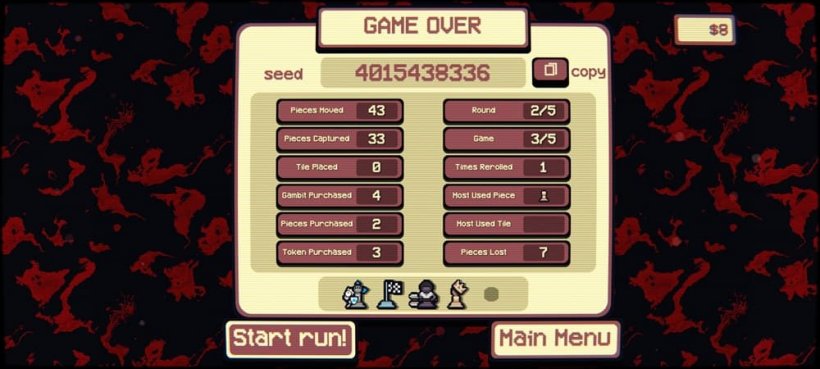
But (and this is a big but), Gambonanza arguably encourages you to master it more than Balatro does. With Balatro, it requires you to keep track of a lot of moving parts. But Gambonanza (if you accrue enough pieces early on) rewards strategic thinking and skill. Luck still plays a part, but it's not impossible to win by the skin of your teeth if you play it smart, although one wrong move can halt even a pretty auspicious start. As you can see below.
A worthy successor to a bona fide spark of creative genius? Maybe. A very fun little roguelike 'deckbuilder' all of its own that shows the developer's chops and is well worth playing if you're more a fan of chess than poker? Definitely.
Put it this way - I'm undoubtedly going to go back to Gambonanza and try to beat it. Which I suppose is the best endorsement of a puzzler you can hope for.


Gambonanza review - "Checkmate (or is it?)"
Gambonanza may not be the legitimate crowd-pleasing smash hit that Balatro was. But it does for chess what the latter did for poker, and manages to reward smart play and skill just as much, if not more, than Balatro ever did. A must-play if you're a chess fan who likes roguelike deckbuilders, but if you're getting tired of the genre, then this may not do enough to lure you back in.


Iwan Morris
Iwan is a Cardiff-based freelance writer, who joined the Pocket Gamer Biz site fresh-faced from University before moving to the Pocketgamer.com editorial team in November of 2023.